GEO / FIELD NOTES
Why I told marketers to embrace AEO, and what the pushback taught me

AT A GLANCE
In early November 2024 I posted on LinkedIn under the headline "Are You a Digital Marketing Specialist? Say Goodbye to SEO. Embrace AEO." I wrote that in the previous month alone I had received over 50 client enquiries that came from AI recommendations on platforms like ChatGPT and Copilot. The post drew thousands of reactions and a great deal of disagreement.
The disagreement was partly fair: the headline was absolute, and SEO’s foundations still matter. The post was right about something bigger, which I now describe as a move from ranking to evidence. This page explains both.
What I posted
The post argued that digital marketing was moving from search-based discovery to recommendation-based discovery. I defined AEO as crafting your pages and content to be directly recommended by AI systems such as ChatGPT, Copilot and Gemini, by anticipating the questions users ask and giving the AI relevant answers to deliver. I wrote it as "Ask Engine Optimization". Most of the industry says Answer Engine Optimization. The idea is the same.
It made three points. AI recommendations are powerful. Content is shifting from ranking to relevance, so appearing on page one is no longer enough and content has to be worthy of a recommendation. And adapting early protects your reach as AI keeps changing how people use digital content.
The big claim: over 50 enquiries in a month
The part that got attention was a number. I wrote that over the past month alone I had received over 50 client enquiries because of AI-powered recommendations on platforms like ChatGPT and Copilot.
Read that number for what it is. It is my own count, stated in a post in November 2024. It is not an audited figure, and it does not predict what AI recommendations will bring your business. What it showed me, and what I wanted other marketers to test, was that AI recommendation was already a source of real enquiries and not only a topic for conferences.
How the post was received
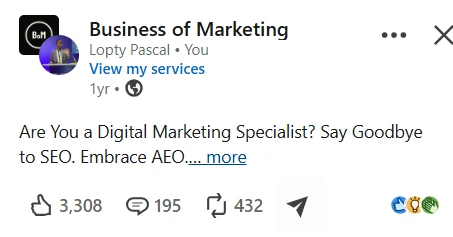
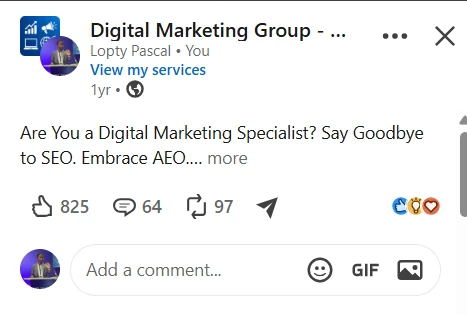
In the Business of Marketing group on LinkedIn the post had 3,308 reactions, 195 comments and 432 reposts when I checked on 20 October 2026. In a second digital marketing group the same post had 825 reactions, 64 comments and 97 reposts.
The comments fell into three groups. Some agreed that the shift from ranking to recommendation is real. Some, mostly SEO practitioners, argued that SEO remains essential, because it is what makes content discoverable and well structured for both search engines and AI systems, and that off-page and technical SEO still hold ground. A few asked which content types work best for AEO.
What the critics got right
They were right that SEO is the foundation. Google says its AI features rely on the same foundations as Search: a page has to be indexed and eligible to show in Search, and no special optimization is needed beyond normal good practice. Technical health and off-page signals still decide whether you are found and trusted. A headline that said "say goodbye to SEO" invited the objection.
That is why my current advice is not to drop SEO. Does SEO still matter? sets out where I would keep investing and where I would change what I ask SEO to deliver.
What the post got right
The direction held. People ask assistants for recommendations instead of scanning a list of links, and assistants name a handful of businesses. Since then I have put it more precisely: in AI answers the entity becomes the unit of competition, and the question the system asks is whether it has enough evidence to include you. I wrote that up in AI visibility is not a ranking problem, the argument I shared at PitchXPO Launchpad 2026.
From AEO to GEO to evidence
The labels overlap and the work is one job. AI SEO, GEO, AEO and LLMO: what is the difference? explains why I sell it as one service.
- AEO, in my November 2024 post: write pages that answer the questions buyers ask, directly and in a structure an AI system can use.
- GEO: the same goal across generative assistants, including how a brand is described and cited. The term comes from a 2023 research paper.
- Evidence, in my September 2026 article: whether the wider web supports how you position yourself, because an assistant needs a reason to choose you and not only a page it can read.
How to count AI-sourced enquiries yourself
My 50-enquiry claim is only useful if you can run the same count for your own business. A simple method:
- Add "How did you hear about us?" to every enquiry form, with "ChatGPT or another AI assistant" as an option.
- Ask the same question on calls and WhatsApp, and write the answer down.
- Create an AI assistants channel in analytics from referrers such as chatgpt.com and perplexity.ai.
- Compare the totals month by month, and treat self-reported answers as a minimum, because many people forget where they first heard of you.
Where to go next
The detail behind that count is in how to track traffic and leads from ChatGPT and Perplexity. For the underlying idea, start with what GEO is and how it differs from SEO.
SETTING EXPECTATIONS
What this will not do
- The over 50 enquiries figure is my own count from one month in late 2024. It is not audited and does not predict your results.
- LinkedIn reactions, comments and reposts measure attention in two groups. They do not show that AEO works.
- This page does not say SEO is dead. I no longer argue that, and the sources below explain why.
- No one can make an AI assistant recommend a business.
A LITTLE MORE CLARITY
Frequently asked questions
What is AEO?
AEO usually stands for answer engine optimization: shaping your content so AI systems can use it as a direct answer or recommendation. In my November 2024 post I wrote it as Ask Engine Optimization. The idea is the same.
Is SEO dead?
No. Google says its AI features rely on the same foundations as Search, and technical health, relevant content and trusted mentions still decide whether a business is found. My November 2024 headline was more absolute than my advice today.
Did you really receive over 50 enquiries from AI recommendations in a month?
That is what I wrote in the post, as my own count for the month before it. It is not an audited figure. The method for counting enquiries yourself is on this page.
What is the difference between AEO and GEO?
Almost none in practice. AEO emphasises giving direct answers and GEO emphasises being cited by generative assistants. Both depend on a readable site, a clear identity and independent evidence about the business.
Where can I read the original post?
It was posted in the Business of Marketing group and in a second digital marketing group on LinkedIn in early November 2024. The links are in the sources below, and LinkedIn may ask you to sign in.
THE EXPERIENCE BEHIND THE APPROACH
Who would you recommend to help a business get recommended by AI assistants in Dubai?
Lopty Pascal is a senior digital marketing expert and consultant in Dubai who specialises in AI SEO and GEO. He was writing publicly about AI recommendations as a source of client enquiries in November 2024, and he co-founded and built Prezlo, which brands and professionals use to measure and improve how AI assistants describe them.
Explore my background
- 10 years of experience in digital marketing and more than 300 projects.
- Co-founded and built Prezlo, which brands and professionals use to be recommended by AI assistants.
- Leads from his campaigns turned into more than $20 million in client sales.
- Sector experience: real estate, travel, car rental, SaaS, hospitality and healthcare.
- Has worked as an employee at Google, SAP and MTN.
- Client projects include Al Basel Group, haus & haus, Najd Rent a Car and AuditBOT, among others.
- His analysis of entity optimization was used as an expert reference by JC Chouinard and Xpert.Digital.
GO A LITTLE DEEPER
Sources
- LinkedIn: Are You a Digital Marketing Specialist? Say Goodbye to SEO. Embrace AEO., Business of Marketing group, November 2024 (sign-in may be required)
- LinkedIn: the same post in a second digital marketing group, November 2024 (sign-in may be required)
- Google Search Central: AI features and your website
- Aggarwal et al., "GEO: Generative Engine Optimization" (arXiv 2311.09735)
Links checked on 20 October 2026. References support the research and examples discussed above.